michele

How New Jersey’s 2026 Child Custody Law Changes Affect Parents

Bergen County child custody lawyers

In January 2026, New Jersey quietly rewrote the rules governing child custody disputes. In one of his final official acts, Phil Murphy signed S4510/A761 into law just before Mikie Sherrill was sworn in as Governor. While the legislation describes itself as merely “clarifying procedures in certain contested child custody cases,” the reality is far more significant.

The law substantially amends N.J.S.A. 9:2‑4, the statute that governs custody and parenting-time decisions when parents separate or divorce. These changes took effect immediately, and their full impact will likely unfold over years of trial court rulings and appellate decisions. What is clear now is that New Jersey custody law has shifted away from long-standing presumptions toward a framework that centers on child safety, individualized decision-making, and children’s voices in custody disputes.

The End of Default Contact and Case-by-Case Decisions

The long-standing directive to maximize a child’s “frequent and continuing contact with both parents” has been removed. Instead, the statute now prioritizes the protection and welfare of the child, both physically and emotionally. Shared parenting remains possible but must serve the child’s best interests, not be assumed as a default.

Courts must make case-specific decisions, taking into account the child’s age, family dynamics, and any safety concerns. Equal legal rights for parents remain, but equal parenting time is no longer presumed.

Safety and Children’s Voices Take Center Stage

Child safety is now explicitly the threshold issue in custody cases. Allegations of abuse, domestic violence, or neglect are evaluated first and heavily influence the structure of custody and parenting time. Safety concerns now carry more weight early in the case than under the previous law.

At the same time, children’s preferences are formally recognized:

  • Courts must consider the views of children mature enough to express reasoned preferences.
  • If a custody order differs from the child’s wishes, the judge must explain the reasoning on the record.
  • In some cases, children may communicate privately with the judge (in camera).

This ensures the child’s perspective is acknowledged and factored into decisions without placing the burden of choice on them.

Court-Ordered Therapy and Abuse Protections

Court-ordered therapy is now strictly limited:

  • Therapy must be evidence-based, safe, and justified by “good cause.”
  • Reunification therapy cannot be forced without parental consent and a determination that the child is capable of meaningful participation.
  • Coercive, isolating, or harmful practices are explicitly prohibited.

Additionally, the statute strengthens protections in domestic violence and abuse cases. Courts cannot presume a child’s reluctance is caused by one parent, nor increase custody to improve a parent-child relationship when there is a history of abuse. Safety and child well-being are the primary considerations in these situations.

Looking Ahead

The law directs the Institute for Families at Rutgers School of Social Work to study the impact of these changes and issue a report by January 2029. While the law is transformative, practical application will evolve through trial and appellate decisions.

Parents involved in custody disputes should present well-supported evidence and work with attorneys experienced in the 2026 law changes to ensure both rights and the child’s safety are fully protected.

Frequently Asked Questions: Child Custody

Q: Does the law change the legal standard for custody?
A: No. Courts still decide based on the best interests of the child, but safety, therapy, and child preference are now more structured factors.

Q: Do these changes affect existing orders?
A: Only if a parent seeks a modification. Existing orders are not automatically revised.

Q: Can therapy still be court-ordered?
A: Yes, but only if safe, evidence-based, and justified. Reunification therapy has additional safeguards.

Bergen County Child Custody Lawyers at Torchin Martel Orr LLC Assist With Parenting Arrangements

If you have questions regarding new or existing custody orders, our experienced Bergen County child custody lawyers at Torchin Martel Orr LLC are available to review your case and discuss your options. Call 201-971-4866 or contact us online to schedule an initial consultation. We have an office in Paramus, NJ.


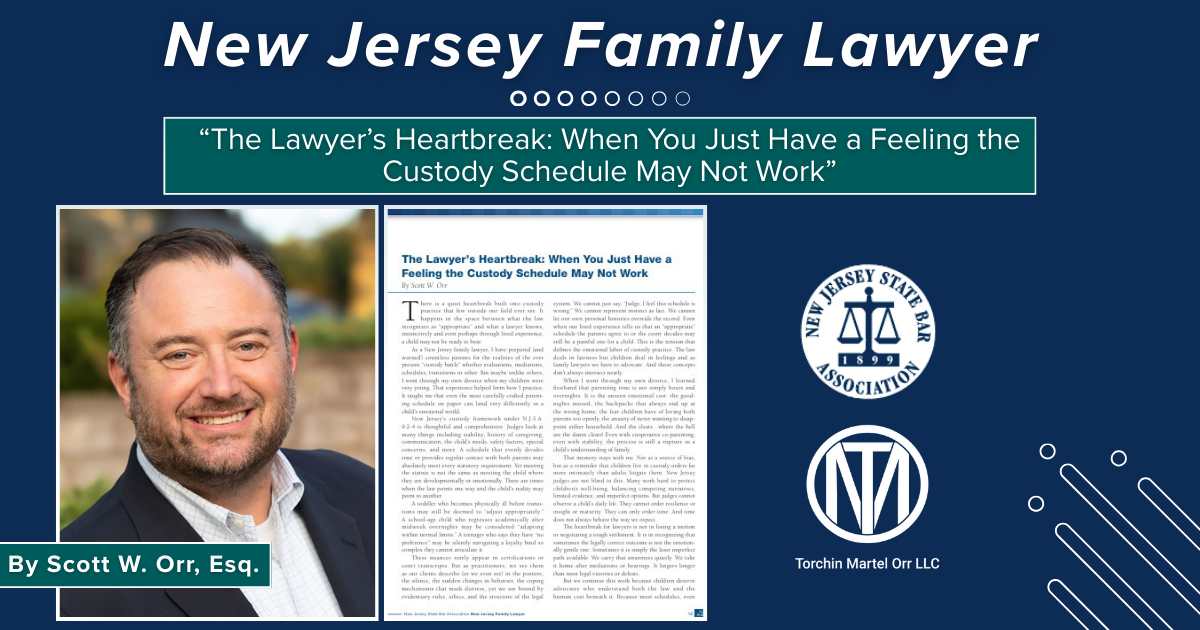
Partner Scott W. Orr, Esq. Published in New Jersey Family Lawyer

NJ family law lawyer

Torchin Martel Orr LLC (TMO Law) is proud to announce that Partner Scott W. Orr, Esq. was recently published in New Jersey Family Lawyer, a professional legal journal that features articles written by attorneys and judges addressing developments, analysis, and practical issues in New Jersey family law.

His article, titled “The Lawyer’s Heartbreak: When You Just Have a Feeling the Custody Schedule May Not Work,” examines the professional and emotional challenges family law attorneys may encounter when a custody arrangement meets legal standards but may not fully serve a child’s developmental or emotional needs.

In the article, Scott explores how custody frameworks, while legally sound, may not always align with the lived realities of children adjusting to divorce. Drawing from both his professional experience and personal insight, he offers practical guidance to practitioners on identifying behavioral and collateral indicators and effectively presenting concerns within New Jersey’s statutory “best interests of the child” factors.

Scott’s publication reflects his ongoing commitment to thoughtful advocacy and advancing discussion within the New Jersey family law community.

You can read the full article in the February 2026 issue of New Jersey Family Lawyer. 

TMO Law is a full-service family law firm built on the belief that every client deserves compassionate and dedicated legal representation. To learn more about our legal services, call 201-971-4866 or contact us online to schedule an initial consultation. We are conveniently located in Paramus, NJ.

Torchin Martel Orr LLC Attorneys Named 2025 Bergen County Top Lawyers

TMO Law attorneys named 2025 Bergen County Top Lawyers

Torchin Martel Orr LLC (TMO Law) is proud to announce that David Torchin, Esq., Brian C. Martel, Esq., Scott W. Orr, Esq., Emily R. Carstensen, Esq., and Eilish M. McLoughlin, Esq. have been recognized by Bergen magazine as 2025 Top Lawyers. Year after year, our team and firm are recognized among Bergen County’s top lawyers and firms.

TMO Law understands your family law matter is deeply private, personal, and important. We provide comprehensive and experienced legal representation in all facets of divorce, equitable distribution, post-divorce, mediation, and child-related matters. We always keep your family’s well-being and needs above all else. Working closely with you, we develop tailored strategies that protect your rights and achieve lasting results.

TMO Law’s enduring reputation for professionalism and results continues to set the highest standard for family-law excellence throughout the state.

If you need guidance with a divorce or family law matter, call TMO Law at 201-971-4866 or complete our online form to schedule a consultation. Located in Paramus, New Jersey, we serve clients in Bergen County and New Jersey at large.

Financial Mistakes to Avoid During Divorce

financial mistakes during divorce

The divorce process can be a complicated experience, particularly if you have children. You and your spouse must resolve various issues, from spousal support and custody matters to the division of marital property. While you may experience a range of feelings, it is essential that you do not let your emotions get in the way of negotiating a fair settlement. Focusing on reaching a fair settlement makes you less likely to make mistakes that could hurt your financial security moving forward. An experienced divorce lawyer will help you make sure that you avoid common financial mistakes.

What Are the Most Common Financial Mistakes People Make During Divorce?

Often, if you are aware of common mistakes people make and the impact they can have on a divorce settlement, you are better able to avoid those mistakes and reach a fair settlement. You should avoid the following mistakes:

  • Not understanding your marital finances. If your spouse generally pays the bills each month, you may not know how much of your monthly income is spent on things like your mortgage, car payments, utilities, and other monthly expenses. Ensure you can access passwords for all joint accounts and familiarize yourself with your financial status.
  • Underestimating expenses. If you do not thoroughly understand your income and expenses, your spouse may take advantage of you during the divorce. You must review your current expenses and calculate your expected future expenses, taking inflation into account.
  • Failing to consider tax implications. If you or your spouse plans to liquidate 401(k) plans or other investments, acquire property through the divorce, or sell the marital home, there will be tax implications. In addition, effective 2018, the spouse paying alimony is no longer eligible for a tax deduction. Your divorce lawyer can explain these complex tax issues or refer you to an accountant with experience with specific tax-related matters.
  • Making important decisions based on emotions. Often, one spouse feels strongly about keeping the marital home for sentimental reasons without considering whether they can afford the mortgage payments, the costs of maintaining the house, and paying for any major repairs that need to be done.
  • Assuming that the marital property will be split evenly. New Jersey is an equitable distribution state, meaning that marital property is divided in a manner that the court deems fair rather than an automatic 50/50 split. Your divorce lawyer will protect your legal and financial rights and negotiate the best possible settlement outcome.
  • Failing to create a post-divorce budget. It is important to understand the financial impact of divorce on both spouses and that the income that supports one household must now support two. When preparing a realistic post-divorce budget, consider your housing costs, expenses for food, health insurance, transportation, children’s activities, tuition, entertainment, and any debts you have accumulated.

Our Paramus Divorce Lawyers at Torchin Martel Orr LLC Help Clients Avoid Financial Mistakes

If you and your spouse are getting a divorce, do not hesitate to contact our Paramus divorce lawyers at Torchin Martel Orr LLC. We will help you navigate every step of the divorce process and negotiate a settlement that protects your assets and financial future. To schedule a confidential consultation, call 201-971-4866 or complete our online form. Located in Paramus, New Jersey, we serve clients in Bergen, Passaic, Morris, Essex, and Hudson Counties, and northern New Jersey.