

Skilled Divorce Attorneys Delivering Results
If you have decided to divorce, you need a compassionate and experienced legal team that understands your difficulties, provides the support you need, and will help you navigate the complex legal process. At TMO Law LLC, our skilled Bergen County divorce lawyers will leverage our collective 100 years of combined legal experience and work collaboratively to focus on your future, protect your rights, and secure the best possible outcome for you and your loved ones.

What Divorce Matters Does TMO Law LLC Handle?
At TMO Law LLC, our Bergen County divorce lawyers represent clients in all aspects of divorce, including but not limited to the following:
- Alimony
- Arbitration
- Child Custody
- Child Support
- Collaborative Divorce
- Division of Marital Assets and Debts
- Divorce
- Domestic Violence
- Guardianship
- Mediation
- Post-Judgement Matters
- Postnuptial Agreements
- Prenuptial Agreements
- Relocation
- Same-Sex Divorce
Client Testimonials for Our Bergen County Family Law Attorneys
⭐⭐⭐⭐⭐
“Scott is an excellent attorney, a true professional, and now a friend. He has my deepest gratitude and highest recommendation.”
– R.O., client
⭐⭐⭐⭐⭐
“David Torchin was highly recommended to me by another lawyer, as the best. He’s a great combination of tough attorney, but caring family man.”
– M.R., client
⭐⭐⭐⭐⭐
“Very sharp and provided sound and equitable advice.”
– N.P., client
⭐⭐⭐⭐⭐
“Brian Martel and his team have been excellent. He has a calm level headedness that cuts through difficult emotional situations. They express a kindness and attention to detail.”
– S.W., client
⭐⭐⭐⭐⭐
“Amazing! Scott and staff work very hard for me and my children.”
– V.B., client
Read More of Our Google Reviews ⭐⭐⭐⭐⭐
Call or Visit Our Convenient Office Location in Paramus, NJ
📞 Call to Schedule a Consultation
🗺️ Get Directions to Our Office
What Are the Grounds for Divorce in New Jersey?
When filing for divorce in New Jersey, you are required to state a reason, legally known as “grounds.” The state recognizes “no-fault” divorce – commonly called uncontested divorce – and “fault-based” divorce.
Most divorces filed in New Jersey are uncontested, citing “irreconcilable differences.” When citing irreconcilable differences, you do not have to add additional information on what led to the dissolution of the marriage. Uncontested divorces are popular because they are often less costly and time-consuming than fault-based divorces.
You may file for a fault-based divorce if you are seeking dissolution under any of the state’s legally required grounds. In fault-based divorces, the filing spouse is responsible for providing evidence supporting the allegations in the divorce petition. Collecting supporting evidence can be challenging without the assistance of an experienced Bergen County divorce lawyer who has a network of investigators and experts to help prepare the required information.
Should I File for Divorce First?
Legally speaking, it makes no difference which spouse files for divorce first. Choosing to file first is a personal decision. However, there are a few advantages to doing so, such as:
- Setting the tone: Whoever files first can present the grounds for divorce, establish strategy, and control the case narrative.
- Increased preparation: Regardless of the type of divorce you seek, the process can be time-consuming and complex. Filing first provides additional time to hire a lawyer, research options, and compile the required supporting documents.
- Location: Divorces are typically filed in the county where either spouse lives. Filing first provides flexibility to file in whichever county is most convenient.
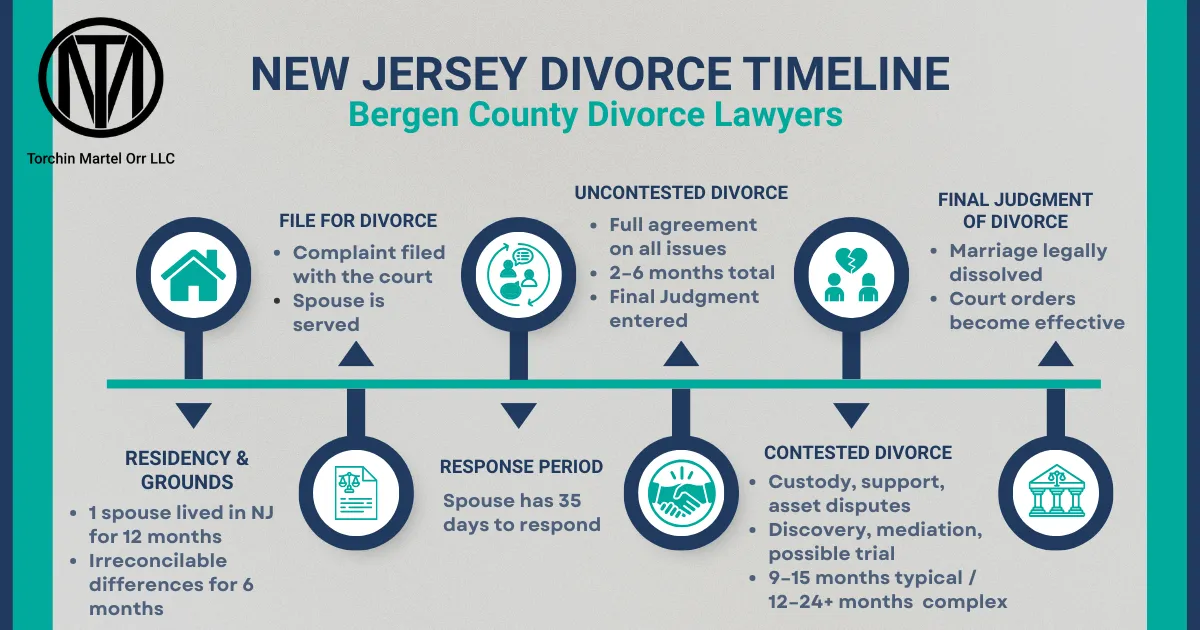
Once filed, you are required to serve your spouse with divorce papers within 30 days, and your spouse has 35 days to provide a formal answer, dispute claims, or file counterclaims. If your spouse does not respond to the divorce petition in the allotted time, the court has leeway to grant your requests and finalize the divorce.
What Costs Should I Expect During Divorce?
The fee to file a divorce complaint with the New Jersey family court is a $300 filing. There is an additional fee of $25 to attend a required parenting workshop if you are seeking child custody or parenting time. If you are the served spouse, filing an Answer or Counterclaim to a Complaint for Divorce is $175. Additional costs typically include:
- Attorney fees
- Mediation costs
- Parenting coordination costs
- Process server fees
Spouses with income at or below 150 percent of the federal poverty level can apply for a fee waiver from the court to eliminate filing costs. The application will require several items, such as your income, assets, and expenses.
Am I Responsible for My Spouse’s Fees?
In certain situations, New Jersey courts have the authority to mandate one spouse to cover the other spouse’s attorney fees, formally known as the “pendente lite award.” This decision is influenced by various factors, including but not limited to:
- Each spouse’s financial resources
- Each spouse’s ability to pay attorney fees
- Complexity of the divorce
- Children’s needs, if applicable
If the court determines that one spouse faces financial disadvantages, it has the authority to instruct the other spouse to cover a portion or the entirety of their attorney fees. This ensures equal access to legal representation for both spouses. Our seasoned Bergen County divorce lawyers can offer legal guidance if you have concerns about covering fees.
Settlement Issues in New Jersey Divorces
There are numerous issues to resolve in New Jersey divorces, including equitable division of assets, child custody and support, and alimony. All of these must be included in a legally binding agreement between the spouses. There are various alternative dispute resolution (ADR) options to help reach an agreement, such as mediation or arbitration. However, courtroom litigation is necessary if ADR is unsuccessful. The court must approve and file the agreement before granting the final divorce decree.
Benefits of Uncontested Divorce
Uncontested divorce offers numerous advantages for couples who can reach a mutual agreement on all terms of their divorce.
One of the primary benefits is faster resolution: Uncontested divorces typically take only a few months to complete, as couples negotiate on their own schedule and avoid expensive, contentious, year-long court proceedings.
Through the uncontested divorce procedure, couples can handle reasonable negotiations in private meetings rather than airing personal matters in court, which can also help children adjust better and recover faster from the divorce.
Additionally, an uncontested divorce allows couples to retain control over their settlement. Since no one understands the family’s unique circumstances better than the couple themselves, they can discuss their requirements and reach solutions that work for everyone involved.
Military Divorce
Military divorce in New Jersey involves federal protections and regulations, which add complexity to the process.
Service members on active duty enjoy protections under the Servicemembers Civil Relief Act (SCRA), which allows them to request a stay of divorce proceedings for at least 90 days during deployment or active duty, plus an additional 60 days afterward.
New Jersey also offers flexible residency requirements for military members: They can file for divorce in the state where they are stationed, where their spouse resides, or where they claim legal residence, even if stationed elsewhere.
Military divorcees must also address issues such as the division of military pensions under the Uniformed Services Former Spouses’ Protection Act, military benefits, and child support calculations based on the service member’s Leave and Earnings Statement.
High-Asset Divorce
High-asset divorce, also known as “high-net-worth divorce,” involves the dissolution of a marriage where one or both parties possess substantial financial assets, typically exceeding $1 million in net worth (these assets can include multiple real estate properties, business interests and partnerships, extensive investment portfolios, substantial retirement accounts, luxury assets such as artwork and high-end vehicles, and potentially offshore accounts or trusts).
There are some key challenges that come with accurately evaluating the net worth of each spouse in high-asset divorce:
- Distinguishing between marital and separate property, especially when one spouse entered the marriage with significant wealth or inherited assets.
- The potential for hidden assets.
- Significant tax implications from asset division and support payments.
- Substantial alimony and child support.
- The need to address lifestyle maintenance for the lower-earning spouse.
Due to the high stakes involved, these divorces often require the expertise of financial professionals, business valuators, and experienced divorce lawyers who understand both the legal and financial complexities.
Helpful New Jersey Divorce Resources
For official court procedures and divorce information, the following resources may be helpful:
Bergen County Superior Court – Family Division (NJ Courts)
New Jersey Courts – Official Divorce Information & Forms
How Can a Bergen County Divorce Lawyer Help Me?
You are not required to hire a lawyer; however, divorce can be challenging and stressful, especially if you are unfamiliar with New Jersey laws. Additionally, the emotions experienced during divorce tend to cloud the ability to make informed decisions. Working with an experienced Bergen County divorce lawyer at TMO Law LLC provides guidance and support during this difficult time. A seasoned divorce lawyer will do the following:
- Determine the divorce grounds.
- Provide objective advice.
- Prepare and file the required documents.
- Maintain steady progress.
- Compile records of all marital assets and debts.
- Establish a fair distribution of marital property.
- Assess spousal support.
- Mediate and negotiate settlement agreements.
- Establish child custody and visitation arrangements.
- Determine appropriate child support.
- Represent you in court if the case reaches trial.
- Ensure your legal rights are protected.
About the Divorce Process in Bergen County
- What are the legal grounds for divorce in New Jersey? New Jersey allows for both no-fault and fault-based divorces. Many spouses in Bergen County file for a no-fault divorce based on irreconcilable differences, which requires demonstrating the marriage has been broken for at least six months.
- How long does the divorce process typically take in Bergen County? Timing varies based on complexity. An uncontested divorce can move quickly, whereas a contested divorce requiring extensive discovery or a trial can take a year or more.
- Can I get divorced in New Jersey if my spouse does not agree? If your spouse does not respond to the divorce complaint, you can ask the court to enter a default judgment to proceed without their participation.
- What is the difference between contested and uncontested divorce? In a contested divorce, the spouses disagree on one or more issues, such as alimony, child support, or property division, requiring court intervention. In an uncontested divorce, however, the spouses agree on all terms and submit a joint property settlement agreement for the court to approve.
Costs, Fees, and Financial Questions
- How much does a divorce in New Jersey cost? The total expense involves filing fees and attorney considerations. The initial filing fee for a divorce complaint is $300, plus an additional $25 if custody or parenting time is an issue.
- Can the court require my spouse to pay my attorney fees? Yes, New Jersey family courts can award “pendente lite” fees in certain situations, which can help level the financial playing field during the proceedings.
- Are any assets or debts protected from division in a divorce? New Jersey follows the rules of equitable distribution, meaning marital property is divided fairly but not always equally.
Children and Support
- How does child custody get decided in Bergen County family court? When deciding custody, the court’s primary focus is the best interest of the child. The courts encourage shared rights and responsibilities, promoting frequent and continuing contact with both parents when appropriate.
- How is child support calculated in New Jersey? Child support is determined using specific state guidelines that consider the gross income of both parents, the division of parenting time, and the child’s needs. The New Jersey family court ensures that both parents contribute fairly to their children’s financial well-being.
- What happens if one parent wants to relocate with the child after divorce? If a custodial parent wants to relocate out of state with a child, they must either have the consent of the other parent or seek a court order allowing the move.
Alternative and Collaborative Processes
- What is collaborative divorce, and how does it work? The collaborative law process allows parties and their lawyers to work together to resolve disputes without going to court. If the collaborative process fails and litigation begins, the parties must hire new attorneys.
- Can mediation reduce divorce costs and conflict? Yes, mediation is often quicker, less expensive, and more private than traditional litigation. A neutral mediator helps both parties communicate and negotiate an agreeable settlement.
Hiring a Divorce Lawyer
- Do I need a divorce attorney in Bergen County? Although you can represent yourself, family law is highly complex. Proper legal representation can help you protect your rights regarding equitable distribution, custody, and support.
- What should I ask my divorce lawyer during my first consultation? You should ask about their approach to communication, how they handle high-conflict situations, and their familiarity with the local courts.
- How are divorce lawyer fees structured in New Jersey? Most divorce attorneys charge an hourly rate and require an upfront retainer. The retainer is placed into a trust account, and fees are deducted as the firm works on your case.
- How familiar is your firm with the Bergen County Family Court system? Located in Paramus, NJ, Torchin Martel Orr LLC regularly navigates the local family court system; our thorough understanding of local procedures helps us effectively advocate for our clients.
- How do you communicate with clients during the divorce process? We prioritize transparent and timely communication, ensuring you are always informed about case developments, court dates, and legal strategy.
Practical Client Guidance
- What documents do I need to prepare for a divorce in New Jersey? You will need to gather comprehensive financial records, including tax returns, pay stubs, bank statements, and documentation of debts to complete the mandatory Case Information Statement (CIS).
- Can I modify custody or support orders after divorce? Yes, you can file a motion to modify a court order if you experience a substantial change in circumstances, such as a significant shift in income or the child’s needs.
- What options exist if my spouse is uncooperative or contested? If your spouse is uncooperative, you have legal avenues to compel their participation or move the case forward. The court can enforce discovery, issue pendente lite orders for temporary financial support, or finalize the divorce through a trial.